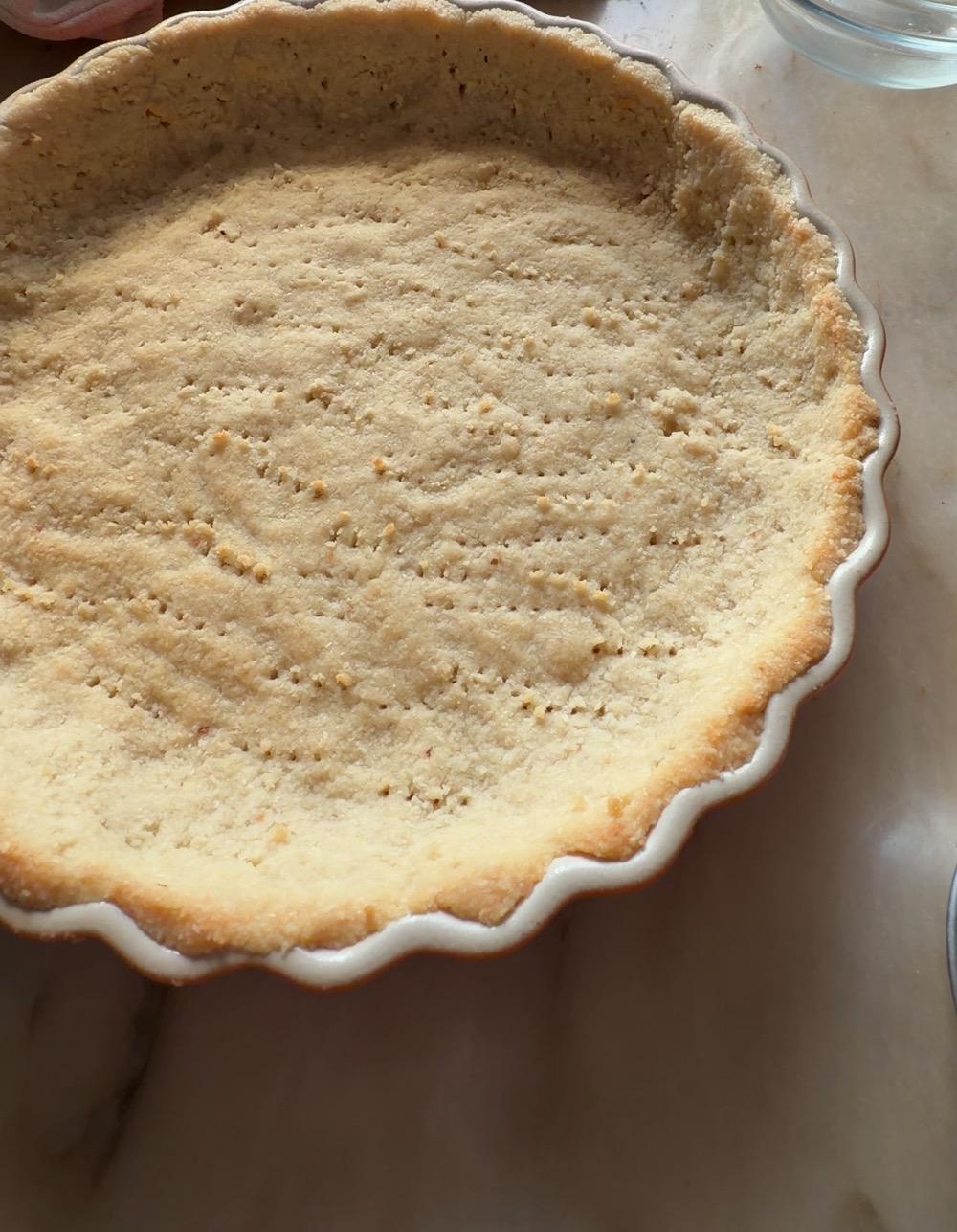
This gluten free pie crust is made without butter and without a rolling pin: almond flour, tapioca starch and melted coconut oil, pressed straight into the pan. Ten minutes of work, no chilling, no cracking.
If your gluten-free pie crust cracks the moment you roll it, crumbles when you lift it, or turns soggy under the filling, the problem is almost never you. It is that most pie crust advice was written for wheat, and wheat forgives things that oat and almond flour do not. Rolling a gluten-free dough is a skill. Pressing one into a pan is not, and that is why this is the crust I make for Thanksgiving.
Why a press-in gluten free pie crust works when a rolled one fails
A classic crust is flaky because cold pieces of butter melt in the oven and leave layers behind. That only holds together if there is gluten around the fat, stretching and trapping it. Take the gluten out and the whole thing depends on getting the water exactly right. Too little and it crumbles; too much and it turns gummy. I tested that method twice and threw both crusts away.
A press-in crust skips the problem. The fat goes in melted, so there are no pockets to protect. Almond flour brings its own fat and a fine, tender texture. Tapioca starch binds. The coconut oil sets as the crust cools and holds everything together. You press, you bake, and it comes out crisp at the edge and firm underneath, every time.
What each ingredient does in this gluten free pie crust
- Almond flour (200 g / 2 cups): structure and flavor. It is about half fat, which is why the crust tastes rich with so little added oil.
- Tapioca starch (30 g / ¼ cup): the binder. It takes the place of gluten and keeps the slices from falling apart.
- Melted coconut oil (55 g / ¼ cup): butter’s job. Refined coconut oil has no coconut taste; unrefined is fine with pumpkin or pear.
- Maple syrup (40 g / 2 tbsp): a little sweetness and better browning. Leave it out for a savory crust.
- 1 egg (or 1 tbsp / 15 ml water): the egg binds and gives a sturdier crust under heavy fillings like pumpkin. Water keeps it vegan; expect a slightly more delicate crust.
The recipe (one 23 cm / 9-inch crust or 12 minis)
Easy Press-In Gluten-Free Pie Crust (No Butter)
Ingredients
Method
- Whisk the almond flour, tapioca starch and salt in a bowl.
- Add the melted coconut oil, maple syrup and the beaten egg (or the water, for a vegan crust). Stir until it looks like wet sand that holds together when you squeeze a handful.
- Press the mixture firmly into an ungreased 23 cm (9 inch) pie or tart pan, bottom and sides, about 4 mm (⅛ inch) thick. Use your fingers, then the flat bottom of a glass to even it out. Prick the base with a fork.
- For a filling that bakes (pumpkin pie, frangipane tart): par-bake 10 minutes at 175 °C (350 °F), add the filling and bake as that recipe says. Cover the edges with foil after 20 minutes so the almond flour does not burn.
- For a no-bake filling: bake 18 to 20 minutes at 175 °C (350 °F), until golden, and cool completely.
- Mini pies in a muffin tin: par-bake 12 minutes.
- Let the crust cool completely in the pan before you touch the removable base. It is fragile while warm and firms up as the coconut oil sets.
Notes
Three rules for a gluten free pie crust that holds
- Press firmly, especially the corner. The flat bottom of a glass packs the base evenly, and the corner where the base meets the side is where crusts break. Press it twice.
- Cover the edges. Almond flour browns fast. After 20 minutes in the oven, lay a strip of foil over the rim, or the edge will be dark before the filling is set.
- Do not touch it warm. Straight out of the oven, the coconut oil is liquid and the crust is fragile. Let it cool completely in the pan before you push up the removable base or cut a slice.
If your gluten free pie crust goes wrong
- It crumbles when sliced: it was cut warm, or the mixture was too dry to hold a handful when squeezed. If you used water instead of egg, add one more tablespoon (15 ml) next time.
- The edge is dark and the middle is pale: the foil went on too late. Cover the rim at 20 minutes.
- It stuck to the pan: this crust releases well from metal; with ceramic, line the base with a round of parchment.
- The base is soggy under a wet filling: you skipped the 10-minute par-bake. It matters most with custard fillings like pumpkin pie.
This is the crust under my dairy-free pumpkin pie, and it works just as well with a frangipane and pear filling or, without the maple syrup, under a quiche. One note on ingredients: in the US, “gluten-free” on a label means under 20 parts per million of gluten, per the FDA’s gluten labeling rule, so check that your tapioca starch and almond flour carry it if you bake for someone with celiac disease.
Want the swaps behind this and every other recipe here? My free guide, Indulge in Wellness, explains what each ingredient does so you can fix any crust, not just this one.